
Row, row, row your boat gently up / down the stream???
Purpose: This blog is created to help readers a) better understand electronic compass [smartphone or rangefinder] residual azimuth deviation errors b) quantify the errors, c) model the errors, d) compensate for [correct] the errors, and e) influence the app vendors to apply the correction method within the affected smartphone app. Basically, we need to know (accurately) whether to go up / down the stream (path) we are traveling on.
Background: Case Study 9
What is the significance of Qiblah?
- “The simple answer to this is that Muslims do not worship their qiblah (the direction in which Muslims pray), nor do they face it for any reason apart from being commanded by God to do so.”
- “Facing the qiblah is, first of all, a test to our ability to obey the commands of God even when we fall short from understanding His wisdom. Muslims, as servants of God, are required to surrender to Him.”
- Reference: https://aboutislam.net/counseling/ask-about-islam/significance-qiblah/#:~:text=Facing%20the%20qiblah%20is%2C%20first,required%20to%20surrender%20to%20Him.
Five Ways to Find Qiblah:
- Use the direction of the rising sun
- Use a sundial
- Use a watch
- Use a magnetic compass
- Use advanced technology (smartphone + qiblah compass app)
- Reference: Wiki: https://www.wikihow.com/Find-the-Qibla-for-Prayer
How to find Qibla direction using your geographical location?
- “By determining the constants of the sinusoid that intersects your (location) and Kaaba’s location, we will find the straight path on the earth’s surface that leads to Kaaba.”
- Kaaba’s geographical location: Latitude = 21.422478 degrees; Longitude = 39.825183 degrees
- The Qiblah azimuth from the Birmingham, AL test location to the Kaaba location is calculated to be 50.79 degrees from True North.
- Reference: https://medium.com/@m.rifathossain/how-to-find-qibla-direction-with-the-help-of-geography-and-mathematics-18a73e862aa7
This post will present the test results of the Android (Samsung S23-Ultra) smartphone & Qiblah Compass app operated at the Birmingham, AL test site within a strong magnetic/electromagnetic field.
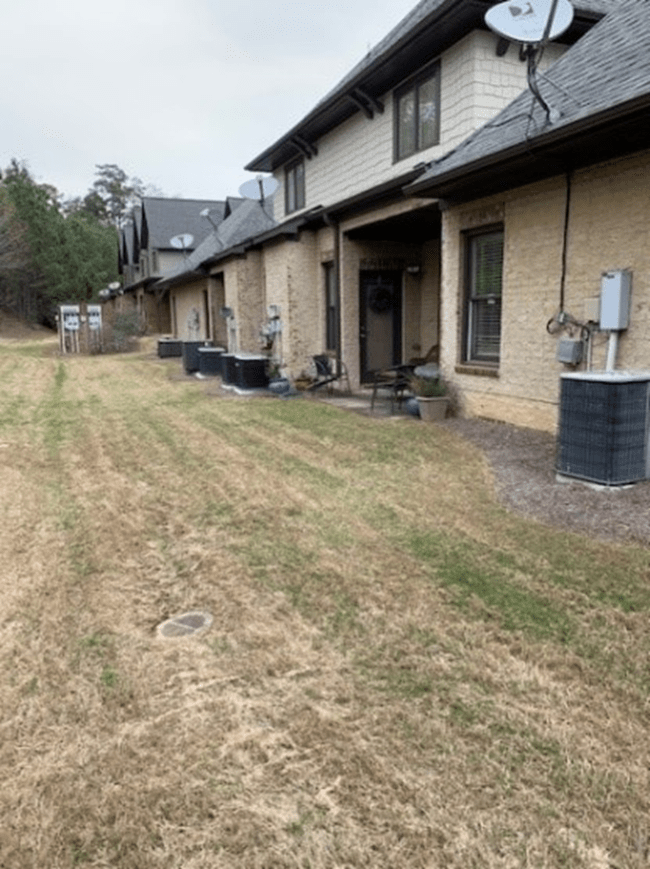
The Birmingham, AL (2-A) test site is set in an urban environment with strong magnetic/electromagnetic influences including:
- An electric power distribution station for eight (8) townhomes
- At least eight operating heating/cooling (heat pump) units of 3 to 4 ton capacity – aligned North/South within 50 feet of the test site (East side)
- An active highway – aligned North/South within 150 feet of the test site (West side)

Reference: The Qiblah direction calculated for this test site was equal to 50.79 degrees from True North.
The data collection equipment and procedures used for this test (Android & Qiblah Compass) were identical to those used at the Birmingham, AL test site for all prior posts. Refer to the original post/page: “http://www.tru-path.org”
- True North (reference direction) was established based on the sun position relative to the test site’s geographic location on the date/time of the test – a correct, defendable, and independent reference direction.
- The Android compass was set to indicate azimuths relative to True North.
- The Android phone’s (Samsung S23-Ultra) compass was re-calibrated prior to this test.
- The Android phone was mounted on a tripod equipped with an indexed compass ring – used to ensure the correct principal directions were achieved prior to taking the actual measurements. Therefore, no “sighting” errors were experienced during data capture operations.
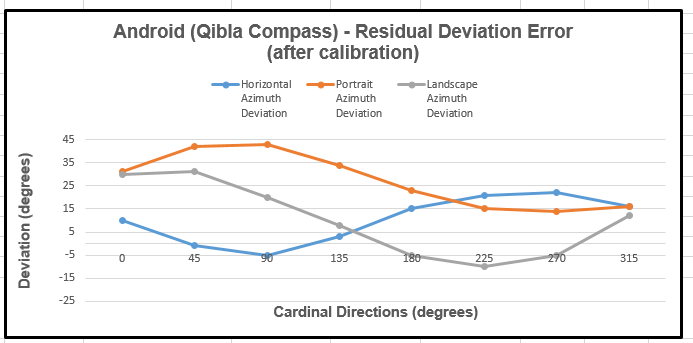
Recall: Residual (after calibration) compass deviation error persists throughout the entire 360 degree range of measurement. The following data table presents the collected azimuth data (yellow) and the associated deviation error (orange) for three Android phone orientations (horizontal, portrait, and landscape). The compass deviation error data was collected in the same manner as all the other error data presented in this blog series.

Notice that the azimuth deviation (error) is different for each orientation of the Android phone. The Qiblah Compass app has done its best – yet residual compass azimuth deviation (error) persist. In fact, the Qiblah Compass app is completely unreliable – especially in the Landscape orientation. The azimuth readings for the Landscape orientation were (as measured) 270 degrees off what should have been the indicated azimuth readings. That is, a value of 270 degrees was consistently added (automatically) to the indicated azimuth readings – in each case.
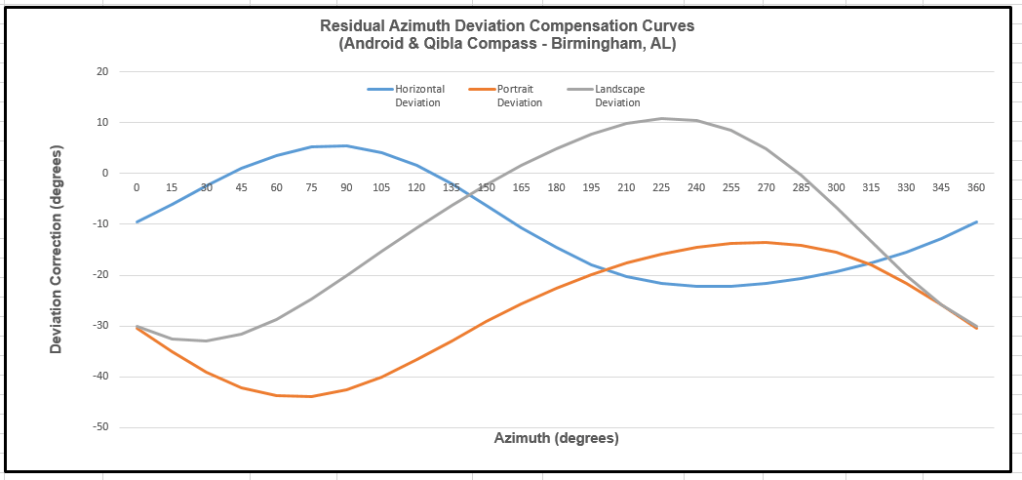
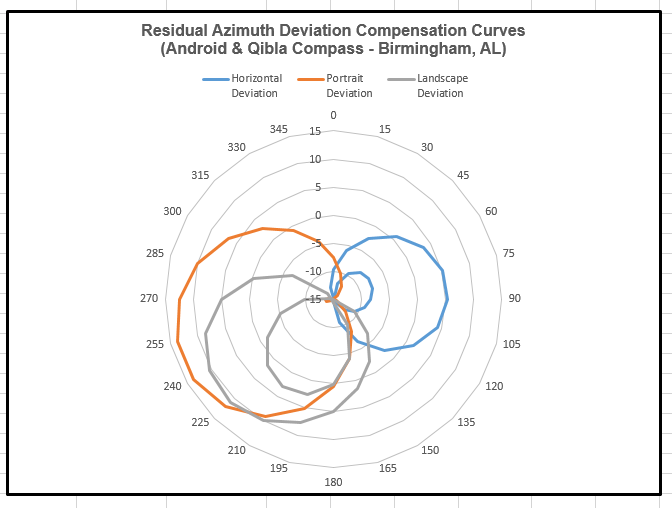
The “modeled” deviation curves (derived from the residual deviation error) for the Android & Qiblah Compass app are presented below. The modeled residual azimuth deviation compensation curves are presented in two different formats to allow the reader to seriously consider the deviation error – as measured throughout the full 360 degree range of measurement.
The compensated deviation errors (remaining azimuth errors after compensation) for the Android & Qiblah Compass app are depicted below. Again, two display formats are provided to strengthen the perceived impact of the compensation method.
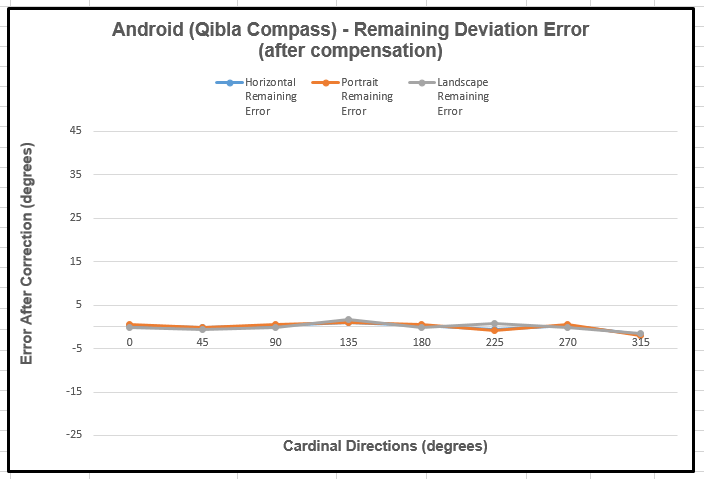
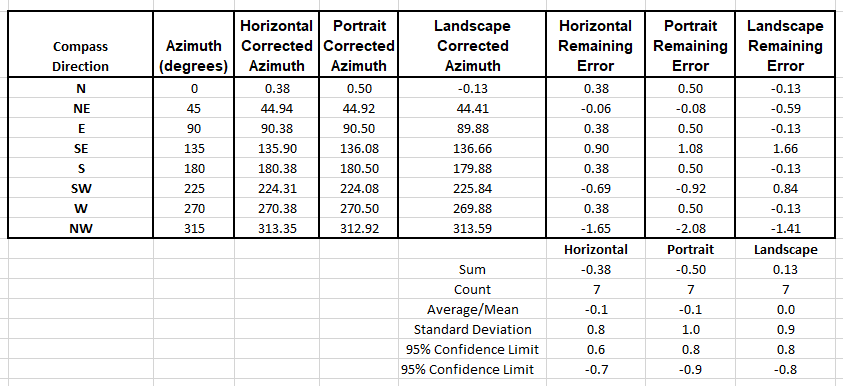
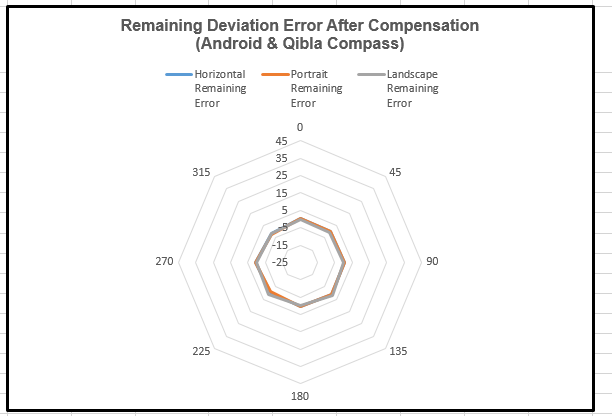
The predicted deviation errors for the Android & Qiblah Compass app are depicted in the following chart. The predicted error curves are the negative of the deviation curves; and the compensation method proved quite effective.

Conclusions:
- The Android & Qiblah Compass app indicate the following error ranges, within a 95% confidence limit: +2.4 < Horizontal < +17.9 / +18.2 < Portrait < +36.3 / -2.1 < Landscape < +22.4 degrees
- The Android & Qiblah Compass app is inaccurate and unreliable to determine the Qiblah direction in all cases – especially in the Landscape orientation.
- The residual compass azimuth deviation error compensation method used in this test (research) is quite effective in compensating the error experienced.
Preview: In upcoming blog posts, we will deal with other Android compass apps. As with previous tests involving the iPhone compass apps, the same methods will be used to collect, analyze, and present the results. The next blog post will deal with the Android & Jerusalem Compass app.
 Tru-Path
Leave a reply to Fixing Rangefinder & Smartphone Residual Compass (azimuth) Deviation Errors – List of Posts – Tru-Path Cancel reply